
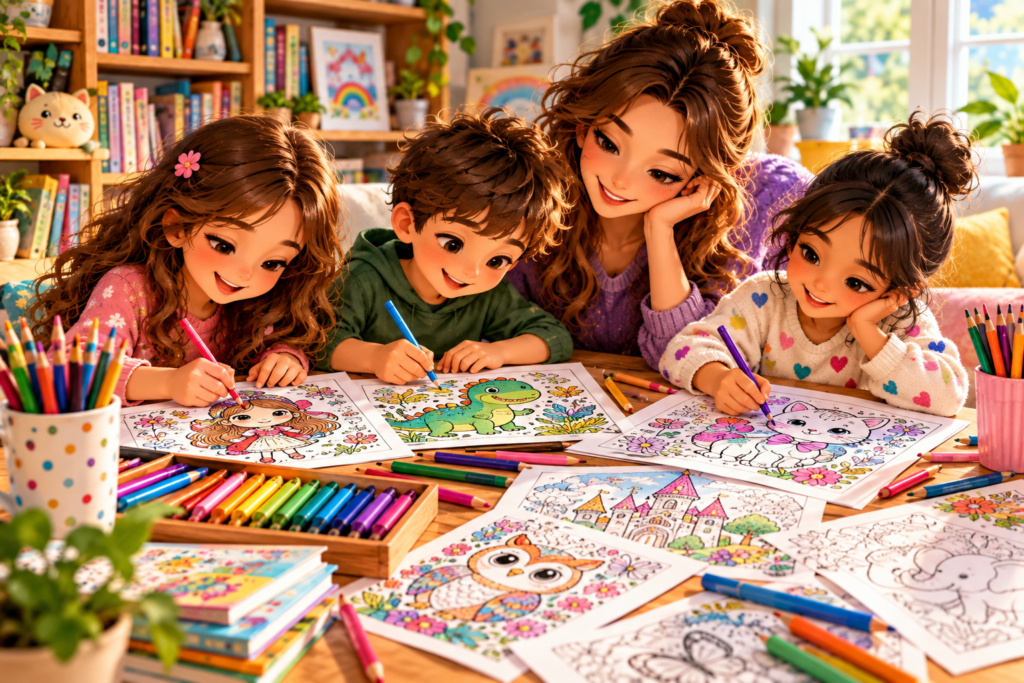
Coloring is often thought of as a simple activity for young children, but it can offer much more than a few quiet minutes with crayons and paper. Coloring benefits for kids can include opportunities to practice hand control, explore creativity, make choices, develop ideas, and express themselves through color and pictures.
Whether a child prefers crayons, colored pencils, markers, or digital drawing tools, the creative process can become a simple way to explore the world around them. And coloring doesn’t have to be limited to one age group. Older children, teenagers, and even adults can enjoy the same creative experience in different ways.
What Makes Coloring a Valuable Creative Activity?
One of the most enjoyable things about coloring is that there is rarely one “correct” way to do it.
A child might color the sky purple, make a green cat, or turn a castle into a rainbow-colored world. These choices allow children to experiment with ideas without worrying about whether their picture looks exactly like someone else’s.
The American Academy of Pediatrics includes coloring books, crayons, and markers among art activities that can support creativity and fine-motor development.
The goal doesn’t have to be producing a perfect picture. Instead, the process of choosing colors, moving a crayon across a page, adding details, and deciding what the finished picture should look like is part of the creative experience.
Coloring Benefits for Kids’ Creativity
One of the biggest advantages of coloring is the freedom to make creative decisions.
A coloring page provides a starting point, but children can decide what happens next.
They might choose:
- The colors of the characters
- The appearance of a magical setting
- What the weather looks like
- Which details to add
- What objects belong in the scene
- What happens next in the story
This can turn a simple coloring page into an opportunity for imagination.
For example, instead of simply coloring a picture of a castle, ask:
Who lives there?
Is it a castle in the clouds? A home for friendly dragons? A secret library? A palace hidden inside an enchanted forest?
There are no wrong answers.
Coloring Benefits for Kids: Supporting Fine-Motor Skills
Coloring also involves repeated small movements of the hands and fingers.
Children gradually develop greater control over how they hold and move crayons, pencils, and markers. Activities such as drawing and coloring can give children opportunities to practice these movements in an enjoyable setting.
The American Academy of Pediatrics notes that drawing, coloring, and similar activities can help children develop hand and finger abilities, while the National Association for the Education of Young Children also lists drawing and writing with crayons, pencils, and markers among activities that support fine-motor skills.
For younger children, simply making marks on a page can be an important part of exploration.
As children grow, they may begin experimenting with:
- Staying inside shapes
- Creating smaller details
- Drawing patterns
- Combining colors
- Tracing shapes
- Adding their own illustrations
- Using different types of coloring materials
There is no need to turn coloring into a test. Letting children experiment at their own pace can make the activity more enjoyable.
Coloring and Children’s Imagination
A coloring page can become the beginning of a much bigger idea.
Imagine a child coloring a picture of a small boat. Instead of stopping when the page is finished, ask where the boat is going.
The boat might be traveling toward a mysterious island. Inside the island, a hidden treasure could be waiting. Along the way, the child might discover a magical animal.
Suddenly, coloring has become storytelling.
This is one reason story-based coloring can be especially engaging. Children can combine pictures, colors, characters, and imagination to create their own little worlds.
You can even ask children to create a name for their character or describe what happens after the scene on the page.
How Coloring Benefits Support Focus and Patience
Coloring can also provide an opportunity for children to spend time on one activity without needing a complicated setup.
Some coloring pages can be completed quickly, while more detailed illustrations may take longer. Children can decide whether they want to finish a picture in one sitting or return to it later.
This can make coloring a flexible quiet-time activity.
However, children are different. Some may enjoy spending a long time adding tiny details, while others may prefer making quick, colorful pictures. Both approaches are perfectly reasonable.
The goal is to make creative time enjoyable rather than turning it into an obligation.
Coloring as a Form of Self-Expression
Colors can become another way for children to communicate their ideas.
A child may choose bright colors because they enjoy them, create a dark scene because they like mysterious stories, or use completely unexpected colors simply because they think they look interesting together.
Instead of correcting those choices, try asking questions.
“Tell me about your picture.”
“Why did you choose that color?”
“What is happening here?”
These questions can encourage children to explain their ideas and turn coloring into a conversation.
UNICEF’s early-child-development resources also encourage children to use drawing materials to express themselves, explore colors and shapes, and develop creativity and dexterity.
Why Story Coloring Can Add Another Layer of Creativity
Traditional coloring pages can be enjoyable on their own, but adding a story can create an entirely different experience.
For example, instead of coloring five unrelated pictures, create a small adventure:
Page 1: A character discovers a mysterious map.
Next, the character follows the map into a forest.
Along the way, a magical creature appears.
Soon, the character discovers a hidden doorway.
At last, a new adventure begins.
The child can decide what colors each character wears, what the environment looks like, and even what happens next.
This approach combines coloring with storytelling and imaginative play.
If you’re new to printable coloring books, you can also read our guide on what a printable coloring book is and how it works.
How to Make Coloring More Engaging
You don’t need an elaborate setup.
A comfortable table, some paper, and a selection of coloring materials can be enough.
Try changing the activity occasionally:
Create a Color Challenge
Choose three colors and see what kind of picture can be created using only those colors.
Add a Story
After finishing a picture, ask the child to create a short story about it.
Color Together
Adults can color alongside children rather than simply watching them.
Try Different Materials
Experiment with crayons, colored pencils, washable markers, or other age-appropriate art materials.
Create a Display
Put finished artwork somewhere visible. A small wall, folder, or art board can become a growing collection of creative projects.
When choosing art supplies for younger children, use materials appropriate for their age and supervise them as needed. The American Academy of Pediatrics provides additional guidance on selecting safe arts-and-crafts supplies.
Why Coloring Benefits for Kids Matter at Every Age
Coloring doesn’t have to stop being interesting as children grow.
Younger children may enjoy large, simple pictures and experimenting with basic colors.
School-age children may prefer more detailed scenes, characters, animals, landscapes, and stories.
Older children and teenagers can explore intricate patterns, fantasy worlds, character design, and their own illustrations.
Adults can also use coloring as a relaxing creative activity or simply enjoy creating something alongside younger family members.
The important thing is to choose pictures and materials that match the person’s interests and abilities, while keeping the coloring benefits for kids enjoyable and age-appropriate.
Make the Benefits of Coloring Part of a Creative Routine
Coloring benefits for kids don’t come from making every coloring session structured or educational.
Sometimes the best creative activity is simply sitting down, choosing a favorite page, and deciding what to do with it.
You can make coloring part of a weekly family activity, a quiet afternoon routine, a storytelling session, or a screen-free creative break.
And when children are given freedom to experiment, their coloring pages can become more than pictures. They can become characters, places, stories, and ideas that continue far beyond the page.
Explore More Coloring Adventures
If your family enjoys combining coloring with imagination and storytelling, explore the Magical Adventures collection at ColorMagicTales for more imaginative worlds to discover.
You can also explore the Worldwide Adventures collection for coloring journeys inspired by different places and cultures.
Coloring benefits for kids are not limited to staying inside the lines. The real adventure can begin when children choose their own colors, create their own ideas, and discover where their imagination takes them.